
Sending the invoice is the easy part. Writing the follow-up email when a client goes quiet is what costs freelancers their evenings.
You sit down to draft it and the cursor blinks. You do not want to sound desperate. You do not want to sound rude. You definitely do not want to lose the client. So you wait another week. Then another. And the longer you wait, the harder the message gets.
This post is the templates that work, the principles behind each one, and a way to stop writing them by hand.
Why following up feels awkward (and why it should not)
Freelancers consistently rate the follow-up email as one of the most stressful parts of the job. The reason is not the math. It is the social contract.
The freelancer feels like they are asking for a favor. They are not. They are following up on a contractual obligation. The work has been delivered. The invoice is past due. The client owes money. Sending a polite reminder is the professional thing to do, not an imposition.
The reframe that helps: think of the follow-up the way a vendor would. When Stripe charges your card and the payment fails, Stripe sends a polite, clear email. It does not apologize for asking. It does not sound desperate. It sounds like a professional system following its own rules. Your follow-up should sound the same.
The timing that works
A simple cadence covers most cases:
- Day 1 past due. Do nothing. Late payments happen. A one-day overdue invoice is not a problem.
- Day 7 past due. Optional soft nudge if the relationship is new or the amount is large.
- Day 14 past due. Friendly first follow-up. This is the standard "your invoice is past due, here is the link" email.
- Day 30 past due. Firm second follow-up. Tone shifts from "checking in" to "this needs to be resolved."
- Day 45 to 60 past due. Final notice. Direct, professional, with a clear consequence (typically: late fee, work pause, or moving to collections).
Most freelancers under-send. They wait too long, then send one email that tries to do too much. Three short messages on a schedule work better than one long message at day 45.
Template 1: The friendly 14-day nudge
Use when: 14 days past the due date, no late fees triggered yet, relationship is fine.
Subject: Invoice [INV-2026-061] for [project name]
Hi [Name],
Quick check-in on invoice [INV-2026-061] for [project name], which was due on [date]. I have not seen the payment land yet, and wanted to flag it in case it slipped through.
You can pay directly here: [payment link]
If there is anything you need from me to process it, just let me know.
Thanks,
[Your name]
Why it works: Short. Names the invoice. Includes the link inline. Offers help. Does not apologize for asking. Does not threaten anything. Most invoices get paid within 48 hours of this email.
Template 2: The firm 30-day follow-up
Use when: 30 days past due, first follow-up was ignored or got a vague reply, no payment landed.
Subject: Outstanding invoice [INV-2026-061]
Hi [Name],
Following up on invoice [INV-2026-061], now 30 days past the original due date. I have not received a response to my previous message on [date], and the invoice is still outstanding.
Could you confirm when payment will be processed? The link is here if it is easier: [payment link]
If there is something I should know about the timing on your side, I am happy to discuss.
Thanks,
[Your name]
Why it works: Names the previous email. Asks a direct question. Offers a conversation, which catches the rare case where there is a real issue (lost invoice, expense approval delays, AP team out for the holiday). No emojis, no qualifiers, no "just."
Template 3: The final notice
Use when: 45 to 60 days past due, two prior messages have been ignored, the relationship is effectively over until this is resolved.
Subject: Final notice on invoice [INV-2026-061]
Hi [Name],
This is the final notice on invoice [INV-2026-061], now [X] days past due. I have sent two prior follow-ups without resolution.
If payment is not received within 7 days, I will [late fee of X percent will apply / pause work on the current project / send the account to collections]. The payment link is here: [payment link]
Please let me know if there is a path to resolving this before then.
[Your name]
Why it works: Direct subject line. Clear timeline. One specific consequence. Still offers a path to resolve. Even at this stage, most clients pay within the 7-day window when the consequence is concrete.
What to never do
The mistakes that cost freelancers the client AND the money:
- Apologize for invoicing. "Sorry to bother you" undercuts the entire message. You are not bothering them. You are running a business.
- Use "just" anywhere. "Just checking in" reads as soft. "Just a reminder" reads as filler. Cut it.
- Write paragraphs. A follow-up email longer than four lines suggests you are not sure what you are asking for. Be specific and short.
- Email at the same time every time. Vary the send time. A Tuesday morning follow-up gets seen. A Friday afternoon one does not.
- Use templates without customizing. Always change the project name, the dates, and the payment link. A copy-paste reminder reads as a copy-paste reminder.
How to stop writing these by hand
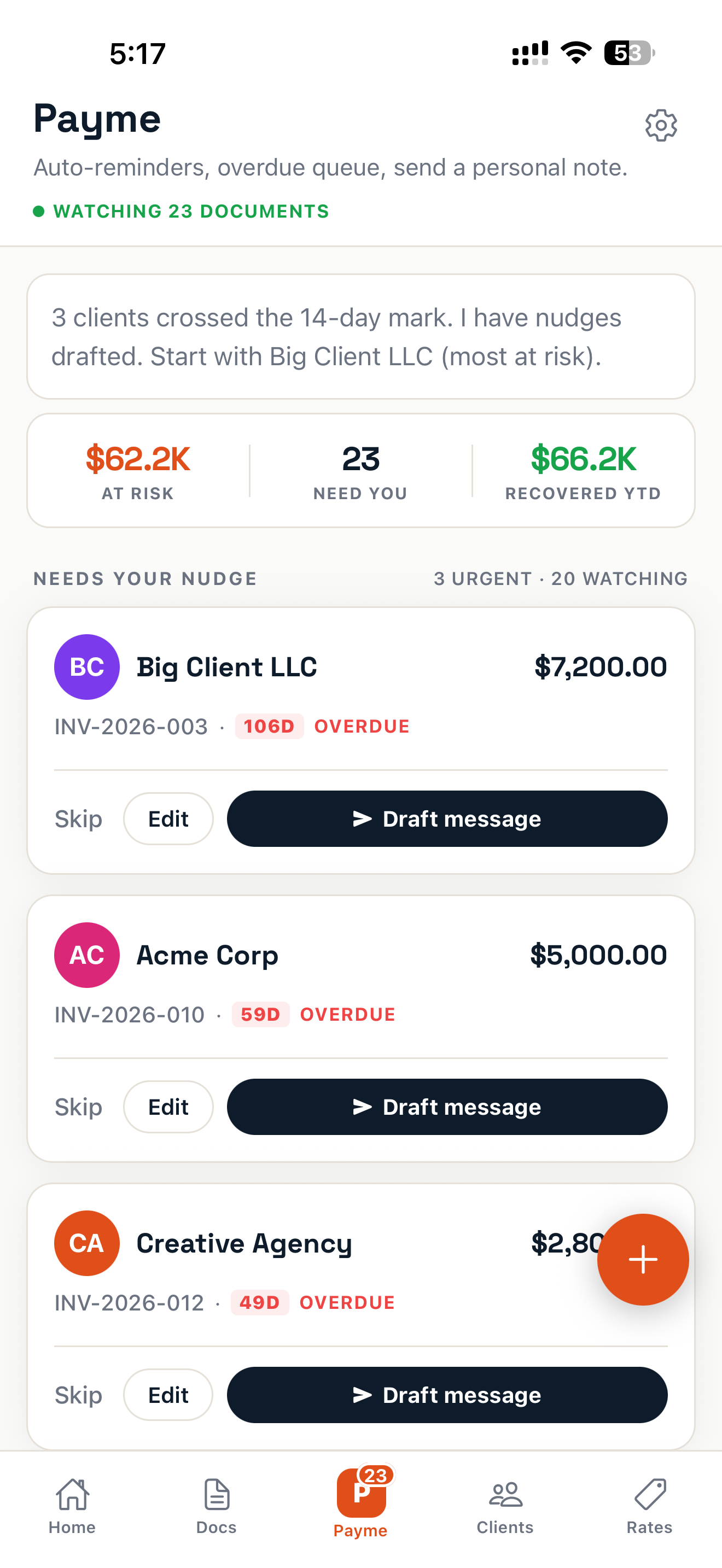
If you send more than a handful of invoices a month, hand-writing every follow-up is friction you do not need. Two automation moves cover most freelancers:
Automatic reminders on a schedule. Most modern invoicing tools fire a 14-day and 30-day reminder automatically once a due date passes. The downside is they all send the same generic dunning email under your name. The cadence is right. The voice is not.
Drafted in your voice. A few tools (including Nvoyce's Payme) draft the actual message in the user's voice with a friendly, firm, or final-notice tone, and let the freelancer review before it sends. The cadence is the same as above. The message reads like a person wrote it because, with one tap of edit, you did.
Either approach beats not following up. The first is hands-off. The second keeps the relationship intact.
For a side-by-side of how HoneyBook, Bonsai, Plutio, Wave, and Nvoyce handle reminders and the rest of the proposal-to-paid loop, see our comparison post.
What to do next
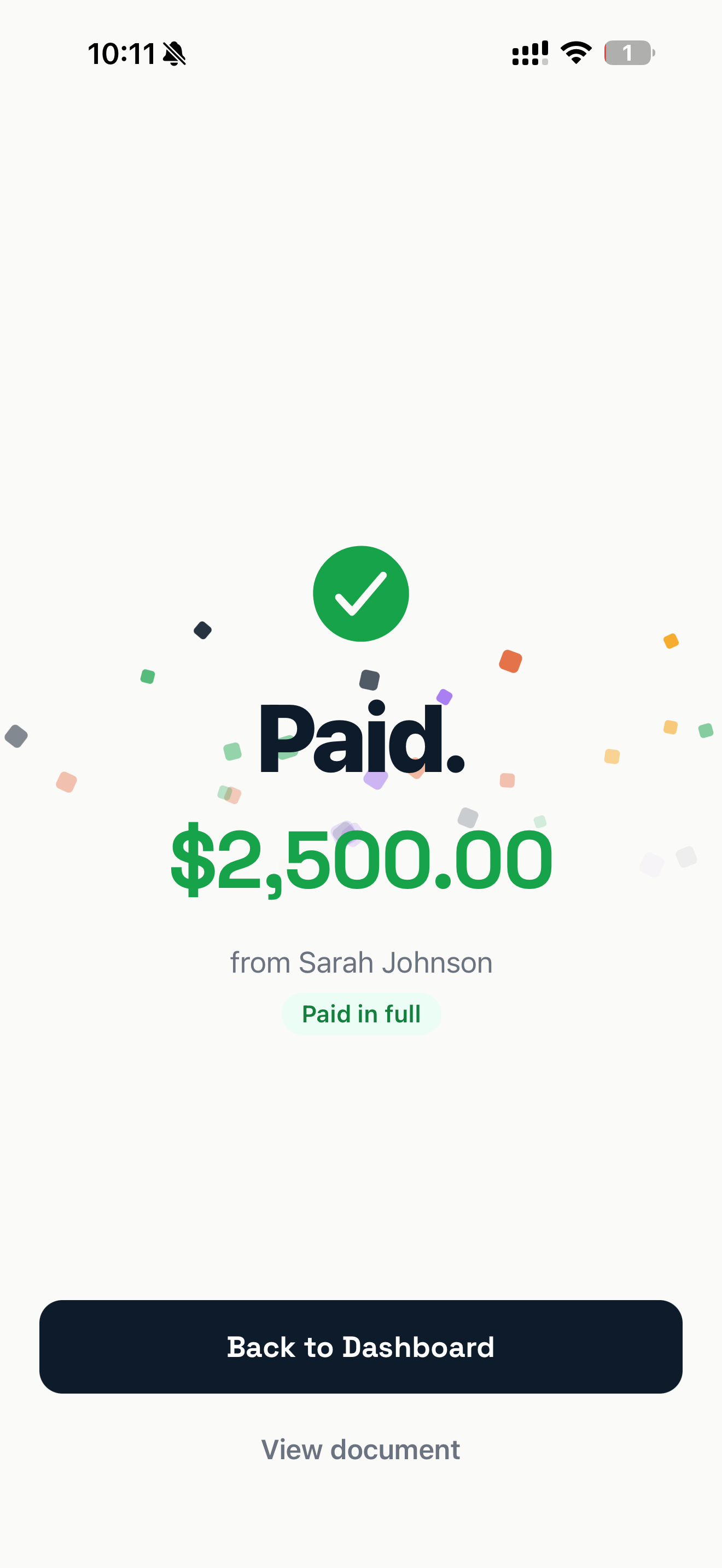
If you are writing every follow-up by hand right now, save the three templates above and use them on your next overdue invoice. They work in any tool.
If you would rather have the message drafted for you and skip the agonizing-at-the-keyboard part, try Nvoyce free for 7 days. No credit card. Full Solo access. See the pricing or read the FAQ first if you want.
The work is done. The follow-up should not cost you the client.
FAQ
When should I send the first follow-up on an unpaid invoice?
14 days past the original due date is the standard first follow-up. Earlier than that risks looking pushy on what may be a routine processing delay. Later than that risks the invoice sliding off the client's radar entirely. If the relationship is new or the amount is large, a soft day-7 nudge can be added.
How do I write a follow-up email without sounding rude?
Keep it short, name the specific invoice, include the payment link inline, and do not apologize for asking. Treat the follow-up the way a professional service would: direct, clear, helpful, no emotional language. The friendly 14-day template above is roughly four sentences for exactly that reason.
Can I charge a late fee on an overdue invoice?
In most jurisdictions, yes, if the late-fee terms were stated on the original invoice or in your contract. Common rates are 1.5 percent per month or 5 percent of the total. If late fees were not disclosed in advance, do not add them retroactively. Update your default invoice template to include the policy going forward.
What should I do if a client ghosts me on an invoice for 60+ days?
Send the final-notice template above. If 7 more days pass without response, the realistic options are small-claims court for amounts under your jurisdiction's cap (often $5,000 to $10,000), a collections agency for larger amounts, or writing the invoice off and pausing all current work for that client. Continuing to work for free for a non-paying client is not a path.
What is the best tool to automate freelance payment follow-ups in 2026?
For freelancers who want hands-off reminders, Wave (free tier, fixed 3/7/14 day cadence), Bonsai, and HoneyBook all send automated dunning emails. For freelancers who want the reminder drafted in their own voice (friendly, firm, or final notice) before it sends, Nvoyce's Payme assistant is the purpose-built option.