
A professional freelance invoice is a legally recognized billing document that must include your identity, your client's identity, a unique invoice number, explicit dates, itemized services, totals, applicable taxes, and clear payment terms. This checklist covers every field you need to get paid accurately and on time. Miss even one element and you risk payment delays, AP rejections, or audit flags. The good news: once you know exactly what goes on every invoice, the whole process gets a lot faster.
1. What are the key identity elements your freelance invoice must have?
Your invoice's identity section is the first thing an accounts-payable team checks. Core invoice fields that every freelancer billing checklist converges on include your full legal or registered business name, your address, your email, and a phone number. If you operate under a business name, use that exact name as it appears on your contracts and tax filings.
The client's identity section is just as critical, and it's where most freelancers make costly mistakes. You must use the exact billing name as it appears on the client's accounts-payable records. A single word difference — like "Inc." versus "LLC" or a missing comma — can trigger an AP rejection and push your payment back by weeks.
- Your legal name or business name (as registered or contracted)
- Your mailing address and contact details (email and phone)
- Your tax ID or EIN if required for tax compliance in your jurisdiction
- Client's full legal billing name exactly as on their AP records
- Client's billing address including department or attention line if applicable
Pro Tip: Before you send your first invoice to a new client, ask their AP department for the exact legal entity name and billing address they need on the invoice. Confirming this upfront can save weeks of payment delays caused by mismatched client entities.
2. How to use invoice numbering and dates correctly in your freelance billing

Invoice numbering is not just an organizational preference — it's a legal and bookkeeping requirement. Gap-free sequential numbering is critical for audits, and any skipped or duplicated number can trigger an audit flag with the IRS or your local tax authority.
A reliable format to use is INV-2026-001, INV-2026-002, and so on. This structure tells you the year at a glance and keeps your records clean. Locking your numbering logic in your invoicing software prevents duplicated or skipped numbers that create reconciliation headaches later.
- Assign a unique number to every invoice with no gaps or repeats.
- Use a consistent format such as INV-YYYY-### for easy sorting and audit readiness.
- State the invoice date clearly as the date you issued the document.
- State an explicit calendar due date such as "Due: July 15, 2026" rather than vague terms like "Net 30" or "due upon receipt."
- Lock your numbering logic in your invoicing tool to prevent accidental duplicates.
An explicit calendar due date matters more than most freelancers realize. Vague due terms are legally weak and give clients room to interpret payment windows however they like. A specific date removes all ambiguity and gives you a firm foundation if you ever need to charge a late fee.
Pro Tip: Set your invoicing software to auto-increment invoice numbers. If you use spreadsheets, keep a master log with a "last used number" cell so you never accidentally reuse a number after deleting a draft.
3. What details should your freelance invoice's itemized list include?
The itemized section is the heart of your invoice. It tells the client exactly what they're paying for, and it tells the IRS exactly what you earned. Itemized descriptions must be clear and detailed enough to identify exactly what was supplied, including quantity and scope. This is not just good practice — EU VAT Directive Article 226 makes it a legal requirement for VAT-registered businesses.
Vague line items like "Consulting Services" or "Design Work" create confusion and invite disputes. Specific descriptions like "Brand identity design: logo, color palette, and typography guide (3 revision rounds)" leave no room for misinterpretation.
Here is a comparison of weak versus strong line item descriptions: Weak description Strong description "Writing services" "Blog post writing: 4 x 1,000-word articles on SaaS marketing, delivered June 2026" "Development work" "WordPress plugin development: custom checkout flow, 12 hours at $95/hr" "Consulting" "Brand strategy consulting: 3 x 90-minute sessions, June 3, 10, and 17, 2026"
Each line item should include the service name, quantity or scope (hours, deliverables, or milestones), unit rate, and line total. Audit-ready invoicing requires one row per deliverable or time block, aligned with your bookkeeping entries. This makes tax reconciliation straightforward and protects you in any dispute.
- Service or product name: specific and measurable, not generic
- Quantity or scope: hours worked, number of deliverables, or milestone description
- Unit rate: your hourly rate, per-piece rate, or flat project fee
- Line total: quantity multiplied by unit rate, calculated clearly
4. How to correctly calculate and display totals, taxes, and payment terms
This section of your invoice is where money gets real. Clients and their AP teams scan straight to the total, so every number here needs to be accurate and clearly labeled. Field What to include Subtotal Sum of all line item totals before tax or discounts Discount (if any) Amount or percentage deducted, with a brief reason Tax line Tax type (VAT, sales tax), rate percentage, and dollar amount Total due Final amount after all adjustments
Taxes deserve their own line. If you are VAT-registered or required to collect sales tax, state the tax type, the rate, and the calculated amount separately. Do not fold tax into your line item prices. Clients need to see the breakdown for their own accounting, and blending tax into prices creates reconciliation problems on both sides.
Payment terms need to be just as explicit as your due date. Late payment fees such as 1.5% monthly interest can be included on invoices, but they must be stated clearly in the payment terms section. Listing a late fee without prior notice in your contract weakens enforceability, so make sure your client agreement references it first.
- State your accepted payment methods: bank transfer, PayPal, Stripe, ACH, or check
- Include your bank details or payment link directly on the invoice so the client never has to ask
- List your late fee policy: for example, "1.5% monthly interest on balances unpaid after the due date"
- Reference your contract or project agreement if applicable, to reinforce terms
The cleaner and more complete this section is, the less back-and-forth you deal with. Making your due date and payment instructions unambiguous directly speeds up how fast money hits your account.
5. Should you add the word "Invoice" at the top of your document?
Yes, and it matters more than you might expect. Clearly labeling the document "Invoice" at the top helps accounts-payable systems recognize and prioritize it correctly. Some AP software scans for this keyword to categorize incoming documents. Without it, your invoice can get filed as a quote, a receipt, or simply ignored.
Place the word "Invoice" prominently at the top, ideally in a larger font or bold text. Pair it with your invoice number and the issue date on the same header block. This gives AP staff everything they need to log the document in under ten seconds.
6. What optional invoice elements enhance professionalism and speed payment?
Optional elements won't get your invoice rejected if you leave them out, but they make a measurable difference in how quickly clients process your payment. Branded invoices with logos, purchase order numbers, and clear payment instructions improve recognition and reduce AP friction.
Here is what to consider adding:
- Your logo and brand colors: clients who receive a branded invoice recognize it instantly and associate it with a professional relationship worth maintaining
- Purchase order (PO) number: if your client issued a PO for the project, include it on the invoice — many AP departments cannot process a payment without a matching PO number in their system
- Project or job code: useful for clients who track costs by department or project
- A short thank-you note: something like "Thank you for the opportunity to work together. I look forward to our next project" takes five seconds to write and leaves a positive impression
- A direct payment link: if you accept online payments through Stripe or PayPal, include the link directly in the invoice body — the fewer steps between your client and the payment button, the faster you get paid
These elements cost you nothing extra to include and signal that you run a professional, organized operation. Clients who receive polished invoices tend to pay faster because the document looks legitimate and complete.
Key takeaways
A complete freelance invoice requires nine core fields: your identity, your client's identity, a unique sequential number, an issue date, a specific due date, itemized line items with quantities and rates, a subtotal, applicable taxes, and a total with clear payment instructions. Point Details Identity accuracy Use your client's exact legal billing name to prevent AP rejections and payment delays. Sequential numbering Assign gap-free invoice numbers in a consistent format like INV-2026-001 for audit readiness. Explicit due dates State a specific calendar date instead of "Net 30" to remove ambiguity and support late fee enforcement. Detailed line items Write one row per deliverable with quantity, unit rate, and line total for clean bookkeeping and tax compliance. Payment instructions List accepted methods and include a direct payment link or bank details so clients never have to ask.
Why I stopped treating invoicing as an afterthought
For a long time I sent invoices that were technically complete but practically weak. I used "Consulting Services" as a line item description. I wrote "Net 30" for payment terms. I never included my client's PO number because I assumed they would sort it out on their end.
The result was predictable. Payments came in late, sometimes very late. One client's AP team rejected three consecutive invoices because I had the wrong legal entity name. I had been invoicing their marketing division instead of the parent company that actually cut checks.
What changed everything was treating the invoice as a contract document, not a formality. I started verifying billing entity names before starting any project. I locked my invoice numbering in my invoicing software so I could never accidentally duplicate a number. I rewrote every service description to be specific enough that a stranger could read it and know exactly what was delivered.
The other shift was moving away from vague payment terms. "Due: August 1, 2026" is not the same as "Net 30." One is a date. The other is an interpretation. Clients who want to delay payment will always find room in vague language. Specific dates close that gap.
If I could give one piece of advice to any freelancer building their invoice template: spend thirty minutes getting the identity and numbering sections exactly right. Everything else flows from there. A wrong client name or a skipped invoice number creates problems that take far longer than thirty minutes to fix.
— Nnamdi
Get paid faster with Nvoyce
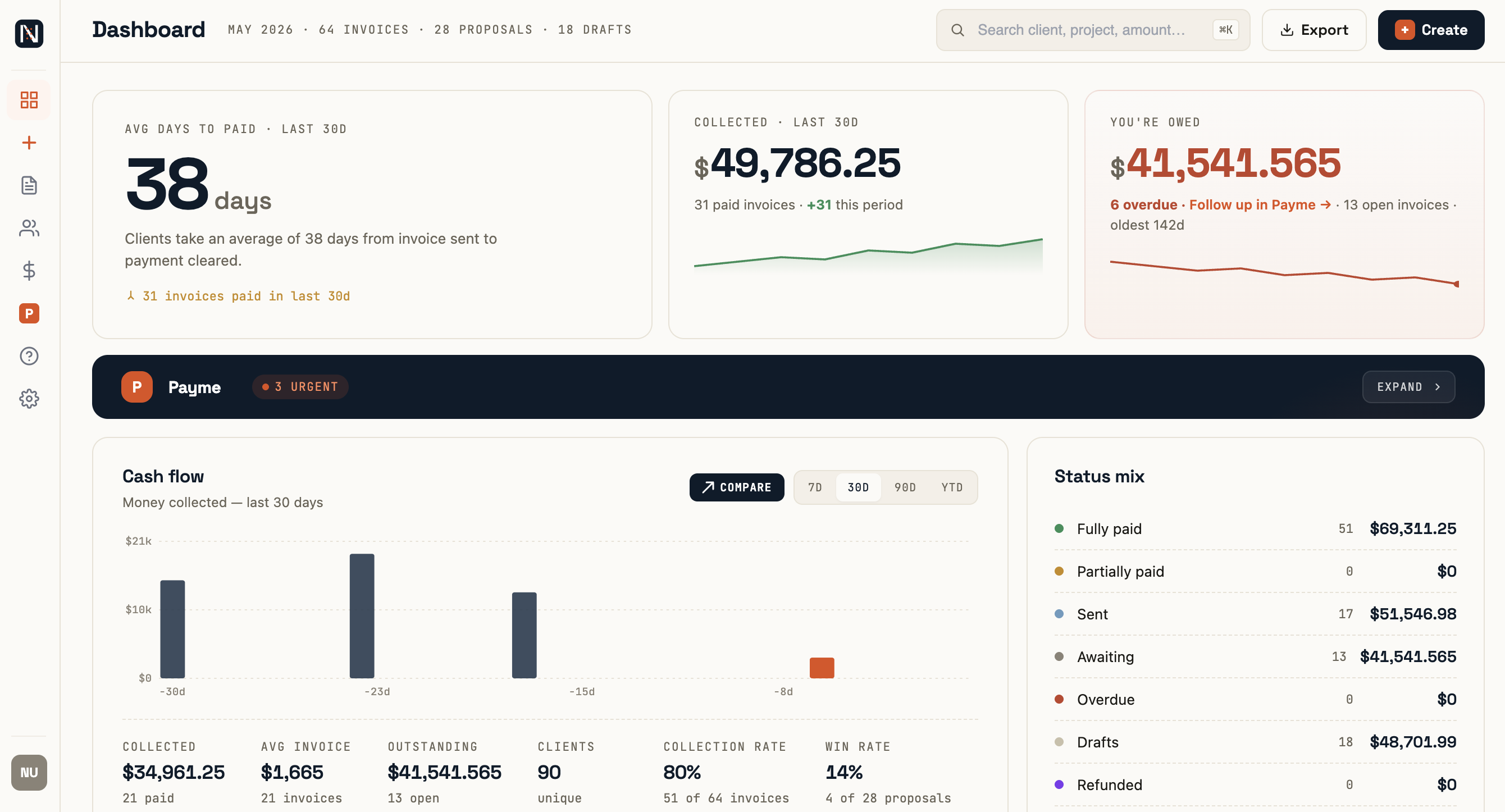
If building and tracking all these invoice fields manually sounds like a lot, that's because it is. Nvoyce is built specifically for freelancers who want to hit send on a complete, professional invoice the moment a client says yes. It handles unique sequential numbering automatically, keeps your client billing details organized, and generates itemized invoices with every field covered in this guide. The built-in Payme feature follows up on unpaid invoices for you — no more chasing, no more awkward reminder emails. Start your 7-day free trial and spend more time on the work that actually pays.
FAQ
What must every freelance invoice include?
Every freelance invoice must include your legal name and contact details, your client's exact billing name and address, a unique invoice number, an issue date, a specific due date, itemized line items with quantities and rates, a subtotal, any applicable taxes, and a total with payment instructions. These core invoice fields are the standard across professional billing checklists.
Why does the client's legal name matter so much on an invoice?
AP departments match incoming invoices against their vendor records. If your invoice uses a slightly different entity name than what is on file, the payment can be rejected or delayed indefinitely. Always confirm the exact legal billing name before you send your first invoice to any client.
What invoice numbering format should freelancers use?
A format like INV-2026-001 works well because it includes the year for easy sorting and uses sequential numbers that satisfy audit requirements. The key rule is no gaps and no duplicates. Locking your numbering logic in invoicing software prevents both problems automatically.
Should I include taxes on my freelance invoice?
If you are VAT-registered or required to collect sales tax in your jurisdiction, yes. State the tax type, rate, and calculated amount on a separate line. Do not fold tax into your service prices, as clients need the breakdown for their own accounting records.
How do I write a late fee on an invoice?
State your late fee policy clearly in the payment terms section — for example: "A 1.5% monthly interest charge applies to balances unpaid after the due date." Make sure your client contract references this policy first, since late fees stated clearly in your terms are more likely to be honored and legally enforceable.
Recommended
- nvoyce — AI invoicing for freelancers
- What Is Invoice Automation? A Guide for Freelancers — How to automate the entire workflow after you hit send
- How to Follow Up Unpaid Contractor Invoices — Escalation steps for independent contractors when reminders stop working