
Following up on unpaid contractor invoices is a systematic process involving timely reminders, clear communication of payment terms, and documented escalation steps to recover what you're owed. The industry term for this process is "invoice debt collection," and it covers everything from a polite first reminder to formal legal action. Freelancers and independent contractors lose real money every time a client goes quiet after delivery. The good news: a structured follow-up process, backed by the right documentation and tools, gives you a clear path from overdue to paid.
What to gather before you follow up on unpaid contractor invoices
Before you send a single reminder, get your paperwork in order. Gathering all essential documents before any follow-up avoids delays and supports legal steps if things escalate. Trying to collect without evidence puts you at a disadvantage from the start.
Here is what you need ready before reaching out:
- Original invoice: Confirm the invoice number, amount, due date, and payment instructions are all correct. A mistake on your own invoice gives the client an easy excuse to delay.
- Signed contract or agreement: This is your proof that the work was agreed upon and that payment terms were accepted. Without it, any dispute becomes your word against theirs.
- Email and message threads: Save every communication with the client from project kickoff through delivery. These threads establish timeline and intent.
- Proof of work completion: Deliverable files, approval emails, project sign-off messages, or delivery receipts all count. The stronger your proof of delivery, the harder it is for a client to claim the work was never done.
- Payment history: If the client has paid previous invoices, that record shows a pattern of engagement and strengthens your position.
Organizing these documents in a single folder — whether in Google Drive, Dropbox, or your invoicing platform — creates an audit trail you can pull up instantly. Invoicing software that logs sent dates, open timestamps, and payment status makes this even easier.
Pro Tip: Turn on read receipts or use an invoicing platform that tracks when a client opens your invoice. That timestamp becomes evidence if a client later claims they never received it.

How to structure your follow-up communication timeline
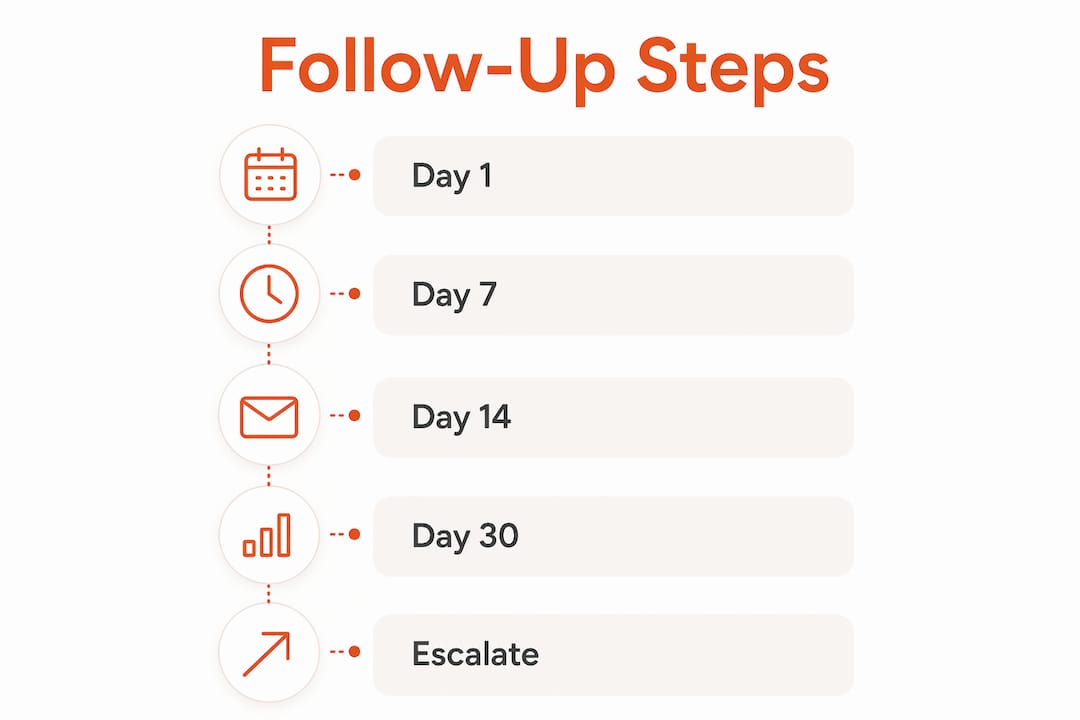
A structured, escalating timeline is the most effective way to request payment without burning the relationship. The US Chamber of Commerce recommends starting with friendly emails and having documentation ready for small claims or mechanic's liens if needed. Think of each stage as a separate conversation, with the tone shifting only when the previous step goes unanswered.
Day 1 (invoice due date): Polite reminder email. Send a short, friendly note referencing the invoice number and total amount. Keep the tone light. Something like: "Hi [Name], just a quick note that Invoice #1042 for $2,400 was due today. Please let me know if you have any questions or need another copy." Most late payments at this stage are genuine oversights.
Day 8 to 14: Second reminder with payment terms. If no response or payment arrives within a week, follow up again. This time, reference your payment terms and mention that late fees of 1.5% to 3% per month may apply if the balance is not settled. Keep the tone professional, not accusatory. Example: "Following up on Invoice #1042, now 10 days past due. As noted in our agreement, a late fee of 1.5% per month applies to overdue balances. Please confirm your payment date at your earliest convenience."
Day 30: Direct request with a confirmed payment date. At 30 days overdue, the tone shifts. You are no longer nudging — you are asking for a specific commitment. Write something like: "Invoice #1042 is now 30 days past due. I need a confirmed payment date by [specific date]. If there is an issue with the invoice or the work, please contact me directly so we can resolve it." Keep it professional, but make clear that inaction is no longer acceptable.
Day 60 and beyond: Final written notice and phone call. At this point, a written notice alone is not enough. Following written chasers with phone calls helps verify receipt and uncover any disputes before you escalate further. Call the client directly, reference your emails, and ask plainly what is preventing payment. Your final written notice should state that you will pursue formal action if payment is not received within a set number of days — typically 7 to 14.
Pro Tip: Match your tone to the stage, not your frustration level. A Day 1 email that sounds like a Day 60 demand will damage the relationship and make the client defensive before you have even tried to resolve the issue.
How to identify and handle disputes or payment obstacles
Not every late payment is a collection problem. Some are disputes, and treating a dispute like a collection issue will make things worse. Figuring out whether nonresponse signals a collection problem or a genuine dispute is the first step before escalating your tone or approach.
Here is how to tell the difference and handle each situation:
- Collection problem: The client acknowledges the invoice and the work but simply has not paid. This is the most common scenario. Stay consistent with your follow-up schedule and consider offering a payment plan if cash flow is their stated issue.
- Dispute: The client questions the quality of the work, claims deliverables were not met, or disputes the agreed amount. Do not escalate to legal threats until you have addressed the specific concern in writing. Ask them to put their objection in writing so you have a record.
- No response at all: Silence is its own category. Follow up through a different channel — a phone call or a message through the platform where you originally communicated. Silence after multiple attempts is a signal to move toward formal action.
- Administrative delays: Large companies sometimes have slow accounts payable processes. Ask for the name of the person handling payment and contact them directly. A client contact who wants to pay you may simply not control the payment process.
- Partial payment offers: If a client offers partial payment, accept it in writing and document the remaining balance clearly. A partial payment can reset certain legal limitation periods, so note the date and amount carefully.
Staying calm and solution-focused during disputes protects both the payment and the relationship. Clients who feel attacked become defensive. Clients who feel heard are more likely to pay.
What legal options are available for persistent unpaid invoices
When communication fails, legal remedies become your next step. Written follow-ups serve as documented proof that can support court proceedings and increase your chances of recovering the debt. Every email, call log, and notice you have sent becomes evidence.
Your main options, compared: Option Best for Key consideration Letter Before Action First formal escalation step Signals legal intent, often prompts payment Small claims court Invoices within your state's dollar limit Requires evidence; no attorney needed in most states Mechanic's lien Property-related contractor work Strict filing deadlines vary by state Collections agency High-volume or older debts Agency takes a percentage of recovered amount Attorney consultation Complex disputes or large amounts Recommended for lien rights and formal litigation
A Letter Before Action sent by recorded mail and email signals that you are prepared to file in court. Harper James recommends attaching the original invoice and giving the client a clear deadline — typically 7 to 14 days — to pay before you proceed.
Small claims court is accessible and does not require an attorney in most U.S. states. You present your invoice, contract, and communication records. The process is designed for exactly this type of dispute.
Mechanic's liens apply specifically to contractors who performed work on real property. Lien deadlines are counted from the last date of labor or material delivery, not the invoice date. In Illinois, for example, you must file within four months of that last delivery date. Missing the notice window forfeits your lien rights entirely, so calendar tracking is not optional.
Legal action time limits for unpaid invoices typically span six years from the due date but can reset with partial payments or written acknowledgments of the debt.
Pro Tip: Document every step you take, including phone call dates, voicemails left, and email open timestamps. Courts and mediators respond to organized, chronological evidence. A messy paper trail weakens an otherwise strong case.
Best practices to prevent unpaid invoices before they happen
The most effective collection tactics are the ones you put in place before a project ends, not after. Automating invoicing and reminders, sending invoices promptly, and offering multiple payment options all reduce delays and improve payment rates.
- Set clear payment terms in every contract. State your due date, accepted payment methods, and late fee policy before work begins. Clients who sign a contract with a 1.5% monthly late fee are far more likely to pay on time.
- Invoice immediately after delivery. The longer you wait to send an invoice, the longer you wait to get paid. Send it the same day you deliver the work, and use a freelance invoice elements checklist to make sure every required field is in place before you hit send.
- Request a deposit upfront. For large projects, ask for 25% to 50% before you start. This filters out low-intent clients and reduces your exposure if payment stalls.
- Offer multiple payment methods. Credit card, ACH transfer, and Stripe all reduce friction. The easier you make it to pay, the faster clients pay.
- Use automated invoicing tools. Nvoyce sends the invoice and a Stripe payment link the moment a client accepts your proposal, and the built-in Payme feature handles follow-up reminders automatically. You stop chasing and start focusing on the work.
- Keep communication professional throughout. Clients who respect you as a professional are more likely to prioritize your invoice over others.
Key takeaways
Recovering unpaid contractor invoices requires a structured escalation process, solid documentation, and the right legal tools applied at the right time. Point Details Document before you follow up Gather your invoice, contract, delivery proof, and email threads before sending any reminder. Follow a timed escalation schedule Move from polite reminder to formal notice over 60 days, adjusting tone at each stage. Distinguish disputes from collection issues Identify whether the client is disputing the work or simply slow to pay before escalating. Know your legal options Letters Before Action, small claims court, and mechanic's liens each serve different situations. Prevent with upfront systems Clear payment terms, prompt invoicing, and automated reminders reduce nonpayment before it starts.
Why most freelancers escalate too fast and document too little
The two most common mistakes when handling late payments are escalating to threats before exhausting polite options, and failing to document anything until it is too late. Most clients who miss a payment deadline are not trying to steal from you. They forgot, their accounts payable team is slow, or they have a cash flow issue they are embarrassed to mention.
The freelancers who recover the most money are the ones who stay calm, keep records from day one, and treat each follow-up as a professional business communication rather than a personal confrontation. When you have a signed contract, a timestamped invoice, and a paper trail of every email you sent, you walk into any dispute or legal proceeding with confidence.
Technology makes this easier than it has ever been. Automated reminders remove the awkward "did you forget about me?" email entirely. When a tool handles the reminder, you preserve the relationship and still get paid. A well-timed automated reminder can recover invoices you had already written off — simply because it landed on the right day.
Legal escalation is sometimes necessary, and you should not hesitate when it is. But it works best when it comes at the end of a documented, professional process, not as a first response to a missed deadline.
— Nnamdi
Stop chasing payments and let Nvoyce do it for you
If following up on every unpaid invoice feels like a second job, you are not alone. Freelancers spend hours on reminder emails that could be automated in seconds.
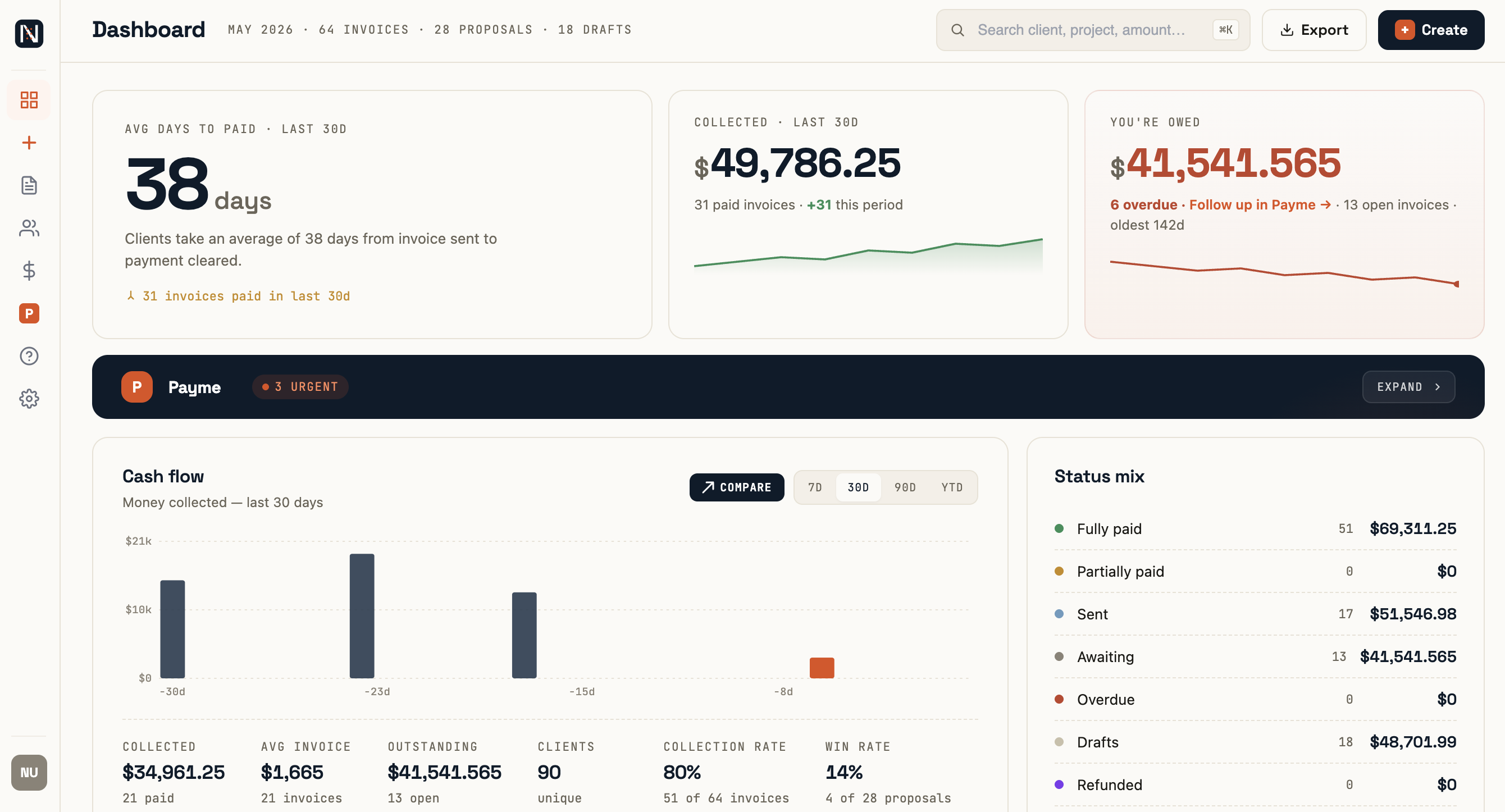
Nvoyce is built for freelancers and independent contractors who want to get paid without the back-and-forth. The moment a client accepts your proposal, Nvoyce fires the invoice and Stripe payment link automatically. Payme then handles follow-up reminders on unpaid invoices — so you never have to write another "just checking in" email. Your clients get a clear, professional payment experience. You get faster cash flow and fewer headaches. Start your 7-day free trial at nvoyce.ai.
FAQ
How soon should I follow up on an overdue invoice?
Send your first reminder on the day the invoice becomes overdue. The US Chamber of Commerce recommends starting with a friendly email and escalating only if the invoice remains unpaid after 30 days.
What documents do I need to collect an unpaid invoice?
You need the original invoice, your signed contract, proof of work delivery, and all written communications with the client. These documents support both direct collection efforts and any legal action you may need to take.
Can I charge late fees on unpaid contractor invoices?
Yes, if your contract includes a late fee clause. Late fees of 1.5% to 3% per month are standard and must be disclosed in your agreement before you apply them to an overdue balance.
What is a mechanic's lien and when should I use it?
A mechanic's lien is a legal claim against a property for unpaid contractor work. Filing deadlines are counted from your last date of labor or material delivery, not the invoice date, and vary by state. Missing the deadline forfeits your lien rights.
How long do I have to take legal action on an unpaid invoice?
The legal time limit for unpaid invoice debt is typically six years from the due date, but partial payments or written acknowledgments from the client can reset that clock.
Recommended
- nvoyce — AI invoicing for freelancers
- How to Follow Up on an Unpaid Invoice — Templates for the 14-day, 30-day, and final-notice nudge
- What Is Invoice Automation? A Guide for Freelancers — How to automate the full invoice-to-payment workflow